
Rhyme Patterns and Types Used in Songwriting
 One fundamental part of a song is its rhyme patterns. This poetic device helps provide appeal to the song’s lyric. Lyrics are written according to certain patterns. These patterns are fairly predictable. That is because rhymes work in a manner that the listener expects to hear.
Do all lines in a song lyric need to rhyme? Not necessarily. With songwriting there is a unique balance between predictability and surprise. If there is too much predictability, then the song can sound trite, boring or uninspiring. On the other end of the spectrum, a song with too many surprises will lend itself to confusion and chaos.
When writing songs, there is no need to reinvent the wheel. You can begin with structures that are proven and work within that framework. As a jumping point for writing a song you can start with some common rhyme schemes. Most song verses will have 4 to 6 lines.
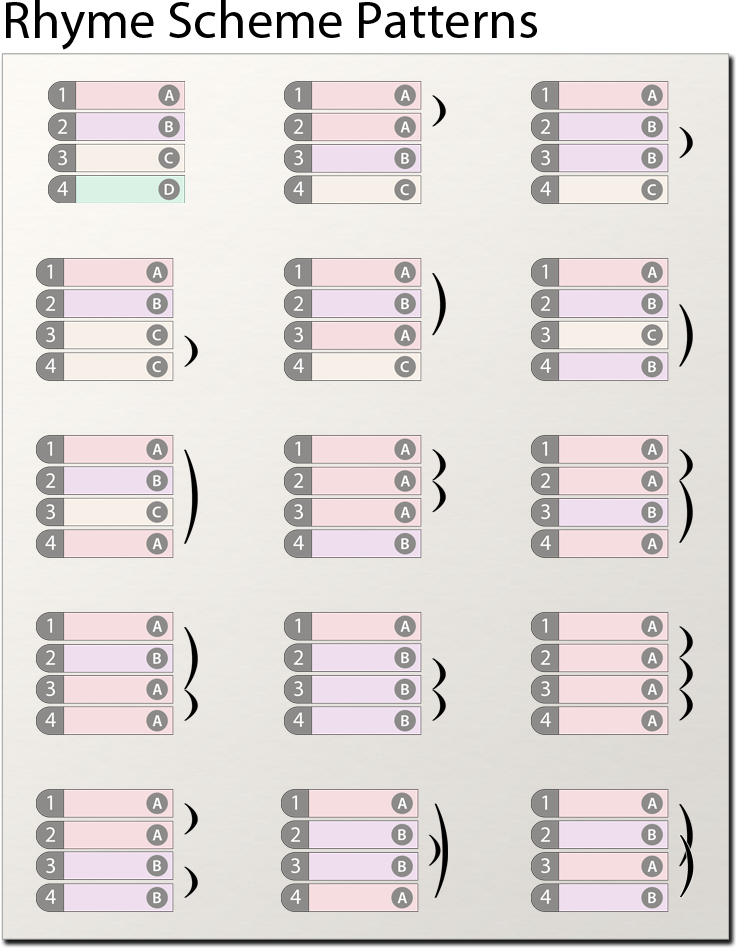
A rhyme scheme is a pattern of rhyme according to the various lines in the lyric. To help you visualize these patterns a letter will be assigned to the line. Matching letters mean that the lines rhyme with each other. ‘X’ means a line that doesn’t rhyme.
Here are some common themes that you can use when you work on your next song.
Rhyming Schemes
The first rhyme scheme is where each line has the same rhyming sound. Most listeners will find that it is too predictable. Therefore it will get old fast.
AAAA
In this next example, the 1st and 2nd lines rhyme and the 3rd and 4th lines have a different rhyme sound. This scheme divides a section of four lines into two rhymed couplets.
AABB
The next rhyming scheme is where each line of the lyric alternate rhyme sounds.
ABAB
The next scheme can be called the sandwich rhyme. It is called this because the 1st and 4th lines surround the 2nd and 3rd lines.
ABBA
Next rhyming scheme is where 2 lines have the same rhyming sound and the other lines do not rhyme. This provides diversity and the element of predictability without the boredom. The two un-rhymed lines will allow you some freedom in your writing.
XAXA or AXAX
Use one of the rhyme schemes above for the verse sections of your next song. Write the scheme at the top of the page and get started. You can also analyze any song and pick out patterns.
Rhyme Types
Along with the patterns for rhyming there are different types of rhymes. As a songwriter you will want to write lyrics using different types of rhymes. Some of these types are strong, others more subtle. Employ these at your discretion. The following are some of the main types :
- End Rhymes – This occurs when rhyming of the final words of lines in a lyric.
- Internal Rhymes – Rhyming of two words within the same line of a lyric.
- Slant or Near Rhymes – This type of rhyme is where two words share just a vowel sound or in which they share just a consonant sound. This is a very subtle but effective technique that provides a nice balance between predictability and surprise.
- Identical Rhymes – Simply using the same word twice.
When lyric rhyme they become memorable and helps with them fit with the music. But use caution, too much rhyming can ruin a song. Understand that a rhyme should come second to meaning of the song’s message. Don’t sacrifice your songs integrity by haphazardly using a rhyme. Rhyme must make sense and help the story not distract from it.
Here are some tools for rhyme patterns in your song lyrics…











Leave a Reply